Project · AI · Safety Technology
SafeHer AI
Proactive personal-safety monitoring with risk scoring.
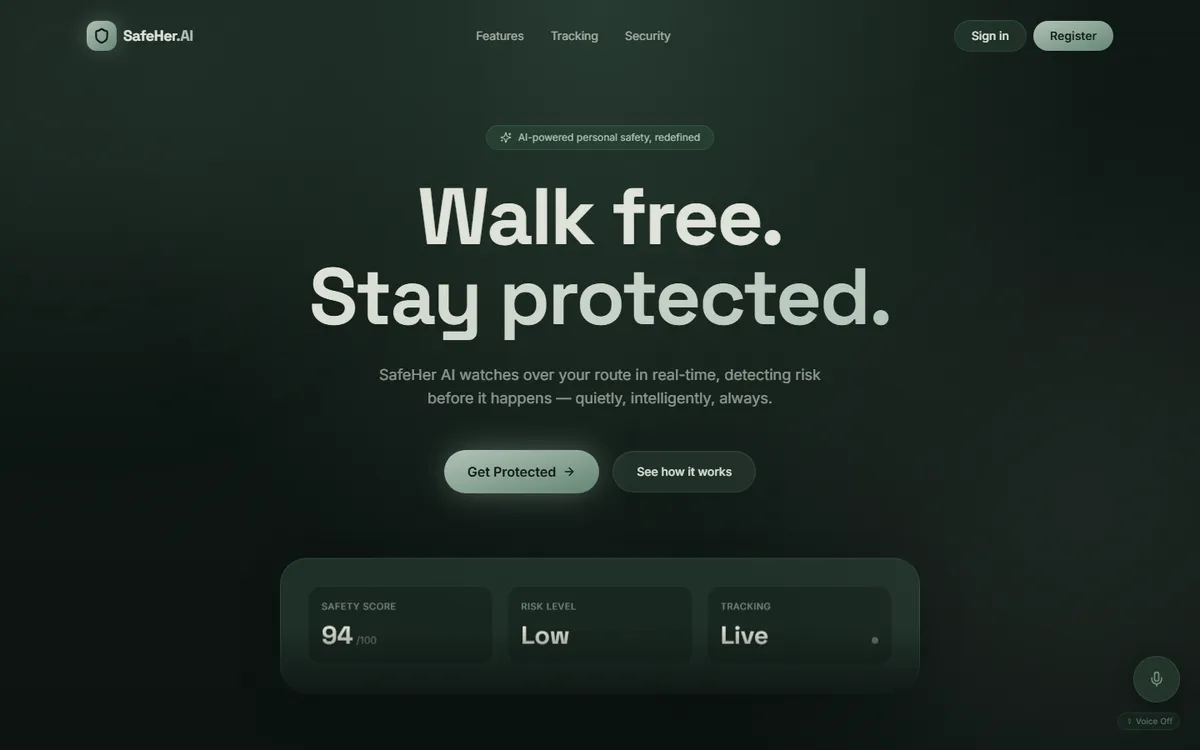
A full-stack safety platform that tracks live route context, scores risk with a scikit-learn engine, listens for spoken SOS phrases, and lets an agentic engine recommend or trigger protective actions as risk rises.
Live demoBuilt at Build And Grow: AI Hackathon 2.0
Live demo — SafeHer AI (opens in a new tab)Source code for SafeHer AI on GitHub (opens in a new tab)
What problem does SafeHer AI solve?
SafeHer AI helps people move with more confidence by combining live tracking, risk analysis, safe-route intelligence and emergency response in one app, so protective actions can start as risk rises instead of only after an SOS.
Key features
- Live location tracking and safety dashboard
- ML risk scoring (time, area, isolation, SOS)
- Voice SOS keyword detection
- Agentic responses by risk threshold
- Safe-route and nearby safe-place lookup
How SafeHer AI works
- Start tracking. The user starts a tracked journey.
- Send context. The frontend sends location and context to the tracking API, which validates it.
- Score risk. The risk engine computes a score and the factors behind it.
- Respond by threshold. 50+ starts active monitoring, 70+ triggers high-risk recommendations, 85+ runs the full emergency workflow.
- Update the dashboard. The safety score (100 minus risk) and alerts refresh.
Architecture
- Frontend: React and TypeScript (Vite, Tailwind CSS, shadcn/ui) dashboard with live route tracking.
- API: Django REST Framework with Simple JWT, split into tracking, agents, alerts, routes and accounts apps.
- Risk engine: A self-contained scikit-learn model scoring time of day, area type, isolation, location source, SOS status and safe-zone proximity.
- Voice SOS: Keyword detection for phrases such as "help", "emergency", "bachao" and "madad".
- Maps: Optional Google Maps APIs for safe routes and nearby hospitals, police and stations.
- Data and hosting: SQLite or PostgreSQL; frontend on Vercel and backend on Render.
Tech stack
- TypeScript
- React
- Vite
- Django
- Django REST Framework
- scikit-learn
- Google Maps
- JWT
Engineering decisions
- The ML risk engine needs no external model file, which keeps it easy to run and deploy.
- When Google Maps is unavailable, the app falls back to default safe zones.
- Production hardening (stricter access rules, host and CORS settings) is still in progress.
Atharva's role
Built with team Deploy House during Build And Grow: AI Hackathon 2.0.
Current status
Live demo at safeher-ai-five.vercel.app; core features are complete and production hardening is in progress.
Sources
Page updated by Atharva Sonar.
More projects by Atharva Sonar
- SpendDecode — AI-powered personal finance and spending intelligence.
- Velquix Learn — Structured roadmaps and curated resources for developers.
- ClaimBlitz — Nine AI agents that process an insurance claim together.
- FitHub Gym — Gym management with a computer-vision rep counter.
- All projects