Project · Multi-Agent AI
ClaimBlitz
Nine AI agents that process an insurance claim together.
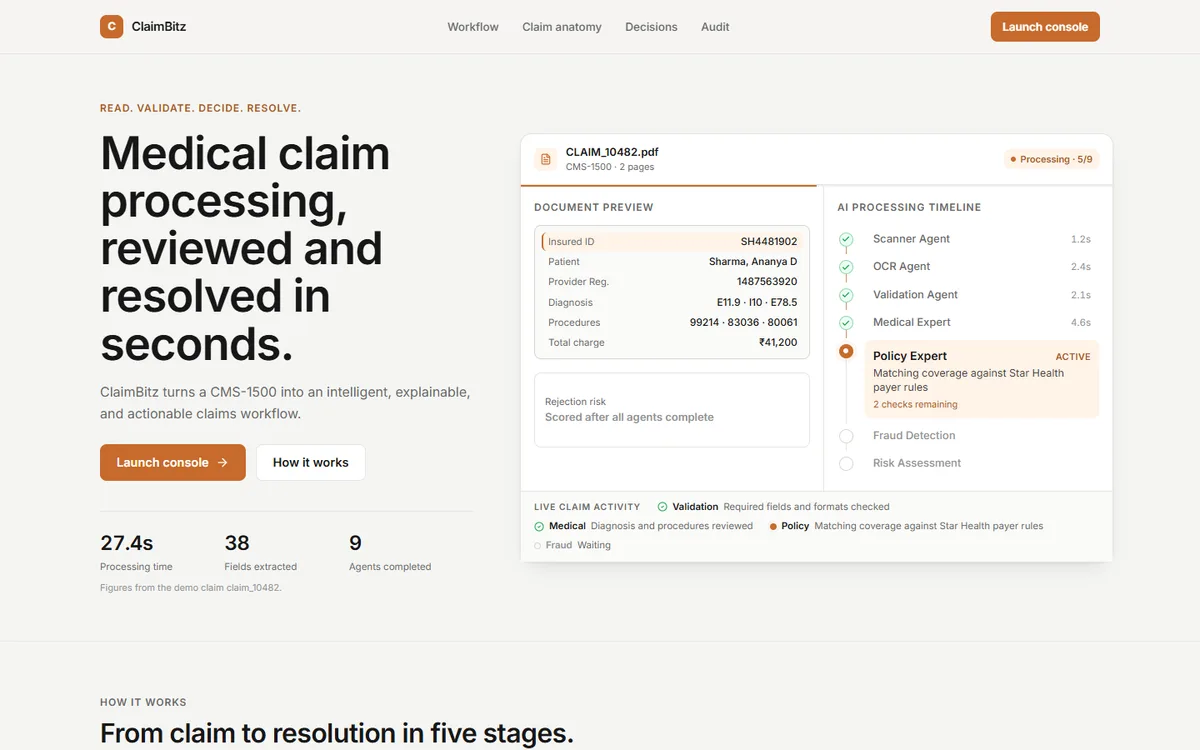
A medical insurance claim processor where specialised agents extract, validate, analyse and decide. When analysts disagree, a structured debate and a judge agent settle the verdict, and low-confidence cases are escalated to a human.
Live demoBuilt at OFFGRID 1.0
Live demo — ClaimBlitz (opens in a new tab)Source code for ClaimBlitz on GitHub (opens in a new tab)
What problem does ClaimBlitz solve?
Medical insurance claims are usually reviewed step by step, which the project's README puts at 30–90 days. ClaimBlitz has specialised AI agents read, check and decide on a claim in one automated pipeline, and hands uncertain cases to a person.
Key features
- OCR extraction from claim PDFs
- Medical, policy, fraud and risk analysis agents
- Debate rounds, voting and a judge agent
- Explainable per-agent findings and human escalation
How ClaimBlitz works
- Scanner. Checks that the uploaded document is a valid claim.
- OCR. Extracts 13+ fields from the claim PDF.
- Validator. Checks formats and ICD-10 and CPT code syntax.
- Analysts. Medical, policy, fraud and risk agents each review the claim.
- Consensus and debate. If analysts disagree, up to two debate and voting rounds run; a 3/4 majority wins.
- Judge. A judge agent rules only when there is still no consensus.
- Human escalation. Decisions below 80% confidence go to a human reviewer.
- Communication. A communication agent drafts the email and SMS to the claimant.
Architecture
- Frontend: React (Vite, Tailwind CSS) agent command centre with live logs, a risk meter and a CMS-1500 document viewer.
- API: Async FastAPI with JWT auth, role-based access and rate limiting.
- Orchestration: A supervisor state machine runs the agents; agents exchange typed messages on a message bus.
- Reasoning: Llama 3.1 8B on Groq through an OpenAI-compatible API.
- Data: MongoDB for claims, Pinecone for per-agent vector memory (optional) and Redis as a shared blackboard.
- Workers: Celery for distributed tasks.
Tech stack
- Python
- FastAPI
- React
- Groq LLM
- MongoDB
- Pinecone
- Redis
- Celery
Engineering decisions
- Groq instead of OpenAI: a free tier, lower latency and the same API format.
- MongoDB instead of Postgres, because claims are nested JSON documents.
- Analyst agents run one after another to stay inside Groq's 30-requests-per-minute limit.
- The judge agent is only called when the analysts disagree.
- Each agent's errors are isolated, so one failure does not stop the pipeline.
- Each agent keeps its own memory namespace.
Atharva's role
Built with team Deploy House during OFFGRID 1.0.
Current status
Hackathon build with a public demo console at claimbitz.vercel.app.
Sources
Page updated by Atharva Sonar.
More projects by Atharva Sonar
- SpendDecode — AI-powered personal finance and spending intelligence.
- Velquix Learn — Structured roadmaps and curated resources for developers.
- SafeHer AI — Proactive personal-safety monitoring with risk scoring.
- FitHub Gym — Gym management with a computer-vision rep counter.
- All projects